Guide
Gaggenau Oven Temperature Problems: Calibration or Fault?
Before you adjust the offset on a Gaggenau oven, find out whether it is actually running off temperature. How to test it properly, and the faults that calibration will not fix.
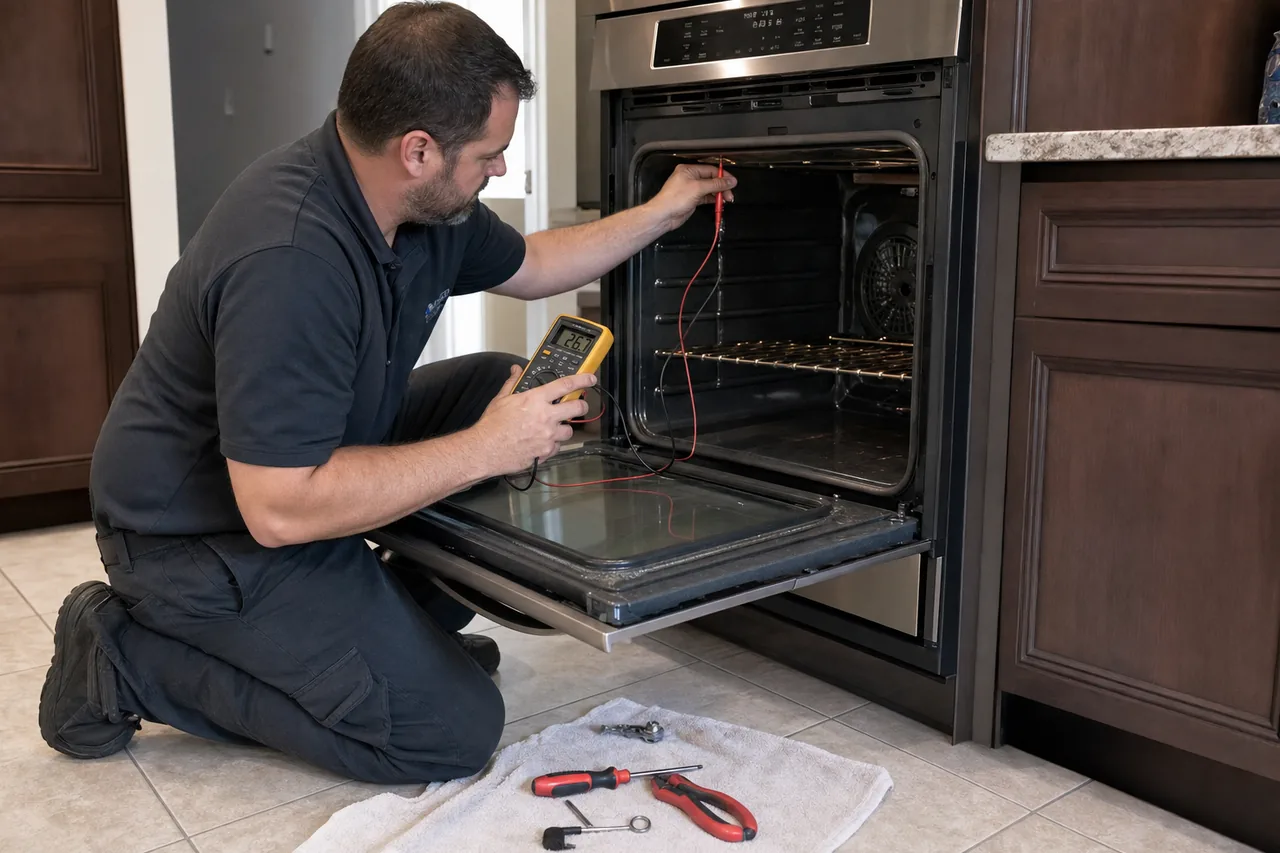
A Gaggenau oven that bakes dark on the bottom, browns unevenly, or takes twenty minutes longer than the recipe says is the call we get most often about these ovens — and the first thing most owners reach for is the temperature-offset setting. Sometimes that is the right answer. More often the offset is fine and something physical has changed, and shifting the calibration only hides the symptom for a few weeks.
Here is how to tell the two apart before anybody touches a setting.
First: an oven is supposed to swing
A thermostatically controlled oven does not hold a flat line. It heats past the setpoint, coasts, drops below it, and fires again. A swing of roughly 15–25°F either side of the set temperature is normal behaviour, not a fault. If you put a thermometer in the oven and read it once, there is a good chance you caught the bottom or the top of a perfectly healthy cycle and concluded the oven is 20 degrees out.
That single mis-read is the reason a lot of ovens get “calibrated” into being genuinely wrong.
How to test it properly
You need an oven thermometer you trust — a dial thermometer that has been knocked around a drawer is not evidence.
- Put the thermometer in the centre of the middle rack, away from the walls and the door.
- Set the oven to 350°F and let it preheat. Ignore the preheat tone.
- Wait a further 20 minutes after the tone. Gaggenau ovens, like most heavy built-ins, signal preheat before the cavity mass and the racks have caught up.
- Now read the thermometer every 5 minutes for 20 minutes and write the numbers down.
- Average them.
If the average lands within about 10°F of 350, the oven is calibrated correctly and the problem is somewhere else. If the average is consistently 25°F or more off in one direction, and the swing between readings is normal, that is a genuine calibration drift.
When the offset is the right fix
Gaggenau ovens expose a temperature-offset adjustment in the appliance settings. The exact path differs between the 200 and 400 series and between generations — the user manual for your specific model number has it, and it is worth finding the manual rather than guessing at a menu. The adjustment range is limited by design, usually on the order of ±20°C / ±35°F.
Use it when:
- the averaged test above shows a consistent offset in one direction
- the swing between readings is normal, not wild
- the oven reaches the (wrong) temperature at a normal speed
That profile is ordinary sensor drift. The oven’s NTC temperature probe changes resistance slightly as it ages, the control reads it faithfully, and the cavity ends up a little cool or a little warm. An offset corrects it cleanly.
When the offset is the wrong fix
Do not adjust the calibration if any of these are true — they are faults, and dialling in an offset will make the oven behave worse once the fault is repaired.
The swing is huge. Readings jumping 50°F or more between checks point at the sensor itself, not its calibration. A probe that has gone intermittent reads plausibly at some temperatures and wildly at others.
It never reaches temperature at all. On a double oven, one cavity that lags badly while the other is fine usually means a failed bake element, a failed relay on the control board, or — in convection mode — a fan motor that has stopped turning. A broken element often still glows in part of its length, so “it looks like it’s working” is not a test.
The top browns but the bottom does not, or the reverse. That is an element or a fan problem, or a rack position problem, not calibration. Calibration moves the whole cavity together.
It was fine last month. Sensor drift is slow. A step change over days is a component that failed, not a calibration that wandered.
Heat is escaping. Put a strip of paper in the door and close it; if you can pull it out with no drag at several points around the seal, the door gasket or the hinges are letting heat out. A sagging hinge on a heavy Gaggenau door is common in kitchens where the oven gets daily use, and the oven will chase the setpoint for ever trying to make up for it.
What we see in Pound Ridge kitchens
Two local patterns show up again and again.
The first is installation. Many of the antique and Halle-restored houses in town have had a modern oven fitted into a cabinet run that was built around existing framing, and the clearances behind and above the appliance are tighter than the specification asks for. A built-in oven relies on air moving through that gap to keep its own electronics cool. When it cannot, the control board and the cooling fan work harder than they should, and the first symptom is usually erratic temperature behaviour rather than an obvious failure. Before assuming a board is bad, it is worth checking whether it has ever had the airflow it was designed for.
The second is power. Most of the town is on overhead lines through the woods, and storm outages and generator transfers are routine here. Ovens draw heavily and are sensitive to a sagging supply: an element that gets less voltage than it expects heats slowly, which reads exactly like a calibration problem from the outside. If your oven’s behaviour changed around an outage, say so when you call — it points the diagnosis at the supply and the relays rather than the sensor.
Steam ovens are a separate case
If the appliance is a combi-steam oven, add one more suspect: scale. Pound Ridge houses run on private wells, and untreated well water here is hard. Scale builds in the boiler and on the level sensors, and a boiler that cannot make steam at the expected rate throws off everything the oven does in combination modes. Descaling on the schedule in the manual is not optional equipment care on well water — it is the difference between a five-year appliance and a fifteen-year one.
The short version
Test the oven properly before you change anything: preheat fully, wait twenty minutes more, average several readings. A consistent offset with a normal swing is calibration. Anything erratic, one-sided, sudden, or slow-to-heat is a part, and the offset will only bury it.
If the test says it is not calibration, or you would rather not spend an hour with a thermometer, call us on (914) 350-6776. We test the actual sensor and element circuit rather than guessing, and most Pound Ridge visits finish in one trip.